// NATURE NEWS — SPAZIO & SCIENZA
Ecological and social cues orchestrate concerted courtship in Drosophila
Nature
(2026) Cite this article
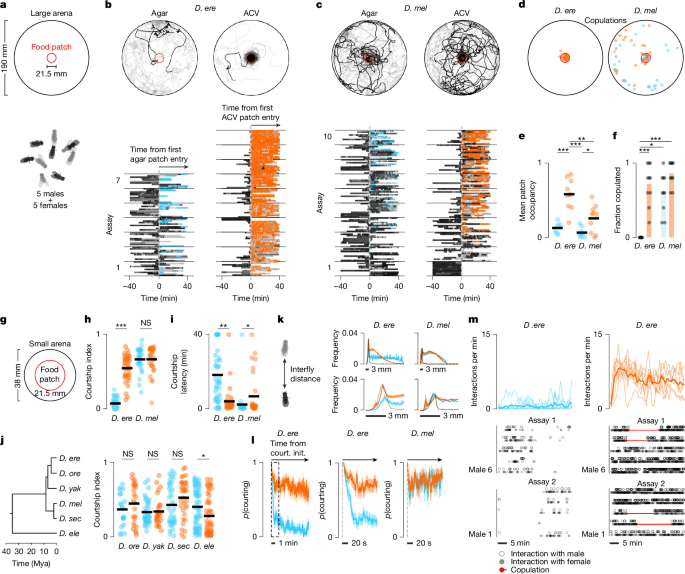
Mating decisions are often attributed to the sensory signalling between prospective sexual partners. Yet these interactions are also shaped by the broader environmental context in which they unfold, to appropriately align sexual arousal with reproductive opportunities1,2,3,4,5,6. Here we show that in Drosophila erecta mating is strictly contingent on the ecological and social environment generated as flies densely aggregate in groups on a food patch. We find that food volatiles directly promote male sexual arousal, triggering individuals to sample and pursue potential mates, giving rise to dynamic interactions across the group. The ensuing visual motion transforms each male’s visual field, which in turn further amplifies his arousal, generating a multisensory feedback loop that coordinately promotes courtship across individuals. D. erecta’s strict dependence on environmental cues appears latent in related species, such as Drosophila melanogaster, where food odour can promote arousal7 but is dispensable for vigorous courtship. Comparative circuit analyses show that species-specific thresholds for sexual arousal reflect variation in how olfactory input modulates conserved nodes controlling courtship drive, rendering food volatiles a strict sensory gate only in D. erecta. Together, our findings highlight how environmental cues not directly tied to sexual signalling can profoundly influence reproductive behaviour and reorganize the social landscape to ensure mating occurs in contexts where reproductive opportunities are abundant.
Social cues are essential for coordinating interactions between individuals, facilitating the emergence of group dynamics including mating, aggression and collective foraging8,9,10. Yet social interactions do not occur in isolation. Rather, they unfold in a broader environmental context that structures when, where and how social behaviours are expressed. Courtship and mating, for example, often take place at ecologically privileged locations—food sources1,2, prominent visual landmarks3,4 or suitable nesting sites5,6—where many individuals aggregate, either to increase their encounters with prospective sexual partners or to access key resources that promote reproductive success. In these settings, a central component of the environment is the social collective itself: the multisensory backdrop that emerges from the movement, sensory signals and interactions across all individuals in a group11,12,13,14. Social behaviours are therefore likely shaped by both the static properties of the physical environment and the dynamic features of the social landscape. Yet the neural mechanisms that integrate these distinct sensory streams to regulate social arousal states and structure interindividual interactions remain largely unknown.
The mating behaviours of Drosophila offer a powerful inroad to explore how animals adapt to complex ecological and social landscapes. Species in the Drosophila genus vary widely in their ecology and geographic distribution15,16,17,18,19,20, raising the possibility that mating strategies have evolved in concert with the diverse sensory environments in which reproduction occurs. Many species, including members of the Drosophila melanogaster subgroup, mate on their host plants, typically decaying ephemeral substrates where many individuals congregate17, creating a complex social backdrop for reproduction. Other species reproduce in more isolated social settings. Drosophila elegans, for example, establish individual territories and mate on their host flowers19, whereas species of the Hawaiian subgroup perform competitive lekking in the vegetation surrounding their hosts20. The evolution of Drosophila courtship behaviours may therefore have been shaped by the distinct sensory ecology of a species’ mating site and the structure and dynamics of the social groups that form there.
Reproduction and population density in Drosophila er