// NATURE NEWS — SPAZIO & SCIENZA
Towards observing interstitial hydrogen in solution in metal lattices
Nature
(2026) Cite this article
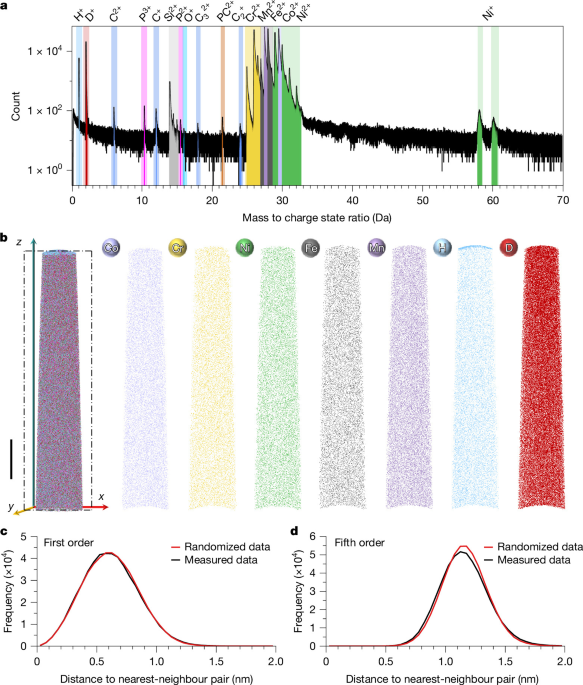
Hydrogen-bearing materials are central to low-carbon energy technologies1, but hydrogen itself is difficult to detect and localize at the nanoscale2,3,4,5,6. This hinders the development of advanced materials with better efficiency. Atom probe tomography (APT) can map hydrogen in three dimensions and at high resolution, yet characterization of dilute, mobile, interstitial hydrogen in metals has remained challenging because of low solubility, the ambiguity owing to hydrogen trapping by structural defects, as well as the artefacts introduced during hydrogen introduction4,5,6. Here we address whether interstitial hydrogen in solution in materials can be distinguished from defect-trapped hydrogen in APT. Using deuterium as a proxy for hydrogen, together with face-centred cubic (FCC) multi-principal-element alloys (MPEAs) containing coherent FCC precipitates, we show that deuterium atoms reproducibly concentrate in hydrogen-affinitive phases in a manner consistent with theoretical predictions. We further resolve differences in deuterium content between phases with distinct local chemistries and crystal structures, consistent with their different calculated hydrogen solution energies. These findings demonstrate that APT can move beyond identifying hydrides and solute-decorated defects to examine hydrogen in solid solution, providing new insights into hydrogen partitioning in structural alloys and informing materials design for hydrogen-related applications.
Hydrogen (H) and hydrogen-containing compounds such as ammonia offer promising routes for low-carbon energy storage and utilization, supporting global decarbonization efforts1. Developing hydrogen energy technologies requires a fundamental understanding of how hydrogen interacts with materials. Hydrogen embrittles high-strength alloys in transport and storage systems2,7,8; its behaviour in metals determines the capacity and reversibility of solid-state storage9; hydride formation in zirconium-alloy cladding threatens fission reactor integrity10; and isotope retention is critical to fusion viability11. Across all of these applications, knowing where hydrogen resides in materials is essential.
Hydrogen in crystalline materials exists in three principal states: dissolved as an interstitial solute in solid solution8, bonded to hydrogen-affinitive elements as thermodynamically stable hydrides (for example, titanium hydride)12,13 or trapped at crystal defects, including vacancies14,15, dislocations3,16 and grain boundaries3,17. Experimentally, these states can be analysed by APT2,4, which uses time-of-flight mass spectrometry to identify hydrogen with nanoscale spatial resolution. In practice, deuterium (2H or D) is often introduced instead of protium to distinguish genuine hydrogen signals from background hydrogen in the instrument, which is predominantly 1H (refs. 4,5).
Among the three states, hydrides and defect-trapped hydrogen have been investigated more extensively by APT. Hydrides are identifiable through their characteristic stoichiometries12,13 and defect-trapped hydrogen can often be co-localized with solute-decorated defects (for example, Cottrell atmospheres such as that of carbon)3,16. When defects are not decorated with identifiable elements, associating hydrogen with defect traps becomes challenging because such defects are ‘invisible’ in APT, unless correlative techniques such as transmission electron microscopy (TEM) are used16,18.
By contrast, characterizing hydrogen in solid solutions is particularly challenging for several reasons. First, the solubility of hydrogen is generally low in many alloys; for example, body-centred cubic (BCC) iron typically contains only a few tens of atomic parts per million (at. ppm) of hydrogen2,7,8, which approaches the APT detection limit6,19. Second, unlike hydrogen in stable hydrides, interstitial hydrogen is highly mobile and can diffuse to the surface and desorb befo