// NATURE NEWS — SPAZIO & SCIENZA
Comprehensive mapping of essential-gene interactions in M. tuberculosis
Nature
(2026) Cite this article
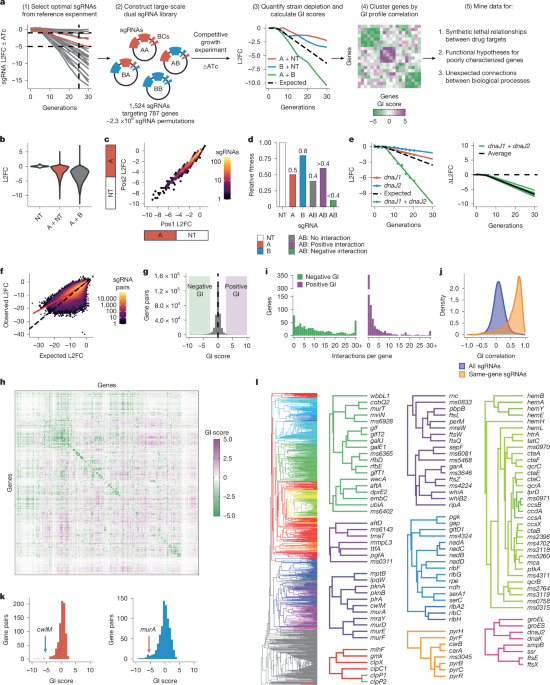
Mycobacterium tuberculosis, the causative agent of tuberculosis, remains the world’s deadliest pathogen1. Despite intensive study, many of its genes remain uncharacterized, which limits the insight that can be gained into tuberculosis biology and constrains drug development. Genetic interaction (GI) mapping is a powerful strategy to define functional relationships between genes by quantifying how the phenotypic effects of combined perturbations deviate from expectations based on single-gene perturbations2,3. Here we develop a dual-sgRNA CRISPR-interference platform that enables high-throughput GI mapping in mycobacteria. We address key technical challenges in library construction and data interpretation by incorporating unique barcodes for each sgRNA pair and implementing a robust statistical pipeline for GI detection. Focusing on essential genes, we generate comprehensive GI maps in the model mycobacterium Mycobacterium smegmatis and the pathogen M. tuberculosis. These maps recapitulate known biology, uncover thousands of previously unrecognized interactions and identify functional connections between essential genes and drug targets. By generating AlphaFold3-based protein–protein interaction predictions4 for all gene pairs in our GI maps, we show that a subset of GIs is likely to reflect underlying physical associations. Validation of selected GIs confirms both novel biological relationships and opportunities for synergistic targeting. Overall, this work establishes a generalizable framework for dual-gene perturbation and defines the architecture of essential-gene networks in mycobacteria, advancing both our understanding of tuberculosis biology and the rational design of combination therapies.
Mycobacterium tuberculosis (Mtb), the world’s leading infectious cause of death1, is among the bacteria that have been most extensively sequenced, but the functions and interactions of many of its genes remain poorly understood. This knowledge gap limits our understanding of the genetic foundations of tuberculosis (TB) and hinders the development of effective therapies.
Genetic interaction (GI) mapping is a powerful approach for deciphering the functional relationships between genes2,3. It involves systematically assessing how perturbing one gene modifies the phenotype associated with perturbing a second gene. A GI is defined as a combined phenotype that deviates from the expectation based on single-gene perturbations. Positive interactions occur when dual perturbation produces a milder phenotype than expected, whereas negative interactions—including synthetic lethal effects—result in a more severe phenotype. Applied at scale, GI mapping yields quantitative interaction profiles that serve as high-resolution phenotypes3. These profiles can generate functional hypotheses for uncharacterized genes, reveal surprising roles for genes of known function and identify connections between distinct biological pathways3. Moreover, they can highlight potential synergistic and antagonistic drug–target relationships, informing combination therapies5.
GI mapping in Mtb has historically been constrained by biological and technical challenges, including slow growth, biosafety requirements and limited early genetic tools. The development of high-density transposon mutagenesis libraries combined with hybridization- or sequencing-based readouts (TnSeq)6,7 constituted a major advance, permitting genome-wide identification of conditionally essential genes8 and GI mapping in deletion mutants9. However, such approaches are typically restricted to non-essential genes, excluding most antibiotic targets. CRISPR interference (CRISPRi) has since emerged as a complementary technique10,11,12,13, enabling conditional and tunable knockdown of both essential and non-essential genes. In bacterial systems, dual-gene knockdowns have been used to identify GIs among small gene sets14, and larger-scale efforts