// NATURE NEWS — SPAZIO & SCIENZA
Hard X-ray attosecond metrology
Nature
(2026) Cite this article
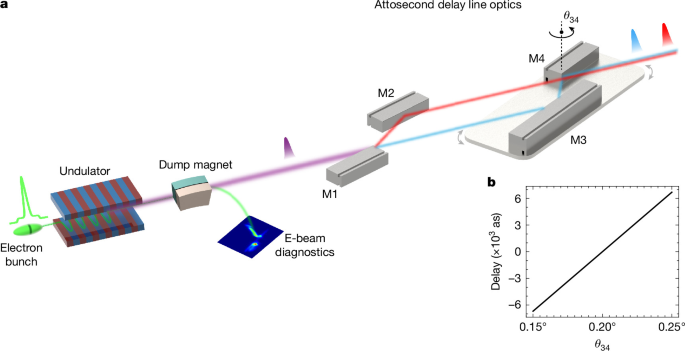
Sub-ångström spatial resolution combined with attosecond temporal resolution enables direct observation of electron motion in matter1. Attosecond hard X-ray pulses generated at X-ray free-electron laser sources provide the requisite spatiotemporal sensitivity, yet their application has been limited by the absence of precise pulse metrology and control. Here, building on a broadband X-ray split-delay line, we establish metrology of attosecond hard X-ray pulses. Field-correlation measurements provide the first time-domain characterization of the pulse coherence time and demonstrate attosecond synchronization between the generated pulse pairs. By exploiting non-sequential two-photon absorption as a nonlinear probe, intensity autocorrelation quantifies the average pulse duration directly in the time domain to be 170 as. The demonstrated experimental tools and techniques enable systematic attosecond time-resolved experiments, including X-ray pump–X-ray probe spectroscopy and diffraction, and open a pathway to probing electronic phenomena with unprecedented spatial-temporal resolution.
This is a preview of subscription content, access via your institution
Access Nature and 54 other Nature Portfolio journals
Get Nature+, our best-value online-access subscription
Prices may be subject to local taxes which are calculated during checkout
All data in this study are available from the corresponding author upon request.
Krausz, F. & Ivanov, M. Attosecond physics. Rev. Mod. Phys. 81, 163–234 (2009).
Article
ADS
Google Scholar
Lewenstein, M., Balcou, Ph., Ivanov, M. Yu., L’huillier, A. & Corkum, P. B. Theory of high-harmonic generation by low-frequency laser fields. Phys. Rev. A 49, 2117–2132 (1994).