// NATURE NEWS — SPAZIO & SCIENZA
Cancer-selective gene circuits via intrinsic ribosomal frameshifting
Nature
(2026) Cite this article
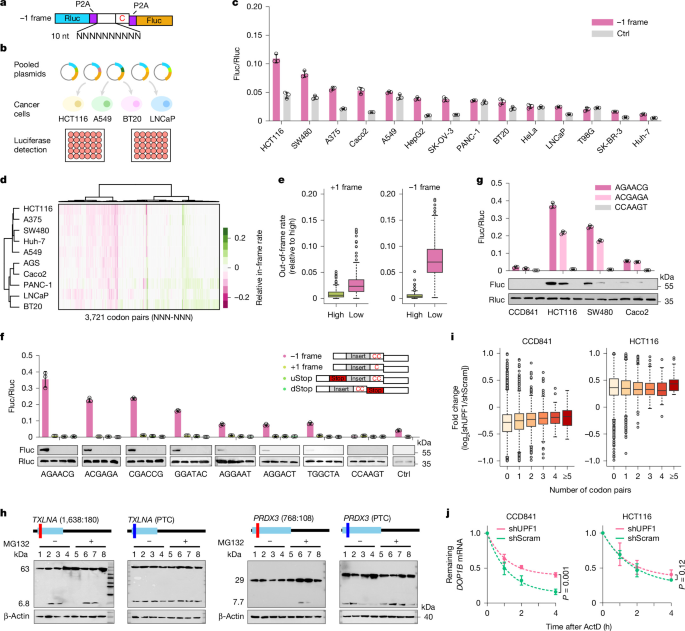
Ribosomal frameshifting, an uncommon translational recoding event, is best known for its regulatory roles in viral gene expression1,2, whereas its physiological relevance in mammals remains poorly understood. Here we show that specific codon pairs trigger efficient −1 frameshifting preferentially in cancer cells. Mechanistically, this recoding arises from ribosomal pausing associated with tRNA and amino acid availability, and is amplified by impaired ribosome quality control and sustained phosphorylation of ribosomal protein S6. We found that this codon-pair-specific frameshifting represents an intrinsic state of translational dysregulation, which is prevalent across cancer cells and reshapes protein synthesis. Taking advantage of this frameshifting-permissive state in cancer cells, we engineered a frameshifting-activated synthetic therapeutic circuit (FAST) that conditionally expresses the pyroptotic effector gasdermin D. FAST is activated across diverse cancer cell types, inducing potent and selective pyroptosis, while sparing normal tissues from detectable toxicity. As a proof of concept, systemic AAV9-mediated delivery of FAST in mouse models of colorectal and pancreatic cancer elicited pronounced tumour regression, robust immune activation and synergistic effects with immune checkpoint blockade. Collectively, these findings reveal codon-pair-dependent ribosomal frameshifting as a feature of translational dysregulation in cancer cells and establish translation-coupled gene circuits as a strategy for cancer-selective therapy.
This is a preview of subscription content, access via your institution
Access Nature and 54 other Nature Portfolio journals
Get Nature+, our best-value online-access subscription
Prices may be subject to local taxes which are calculated during checkout
Ribo-seq, RNA-seq and tRNA-seq used in this study can be accessed under SRA BioProject accession numbers PRJNA1355021, PRJNA1355053, PRJNA1468319, PRJNA1468382 and PRJNA1499311. The MS proteomics data have been deposited to the ProteomeXchange Consortium via the PRIDE partner repository with the dataset identifier PXD076465. Source data are provided with this paper.
The code for data processing and analysis in bioinformatics is fully referenced and described in the Methods. The code for out-of-frame translation based on Ribo-seq is available at GitHub (https://github.com/YHMao-Ribo/FS_from_Ribo) and archived on Zenodo83 (https://doi.org/10.5281/zenodo.20035132).
Hill, C. H. & Brierley, I. Structural and functional insights into viral programmed ribosomal frameshifting. Annu. Rev. Virol. 10, 217–242 (2023).
Article
CAS
PubMed
PubMed Central
Google Scholar