// NATURE NEWS — SPAZIO & SCIENZA
Tracing the spread of Celtic languages using ancient genomics
Nature
(2026) Cite this article
Celtic languages are today restricted to Europe’s Atlantic fringes but were widely spoken across the continent during the Iron Age1,2,3. How Celtic achieved this early distribution remains contested4, with alternative archaeological and linguistic models proposing different homelands and dispersal routes. Here we analyse genome-wide data from 4,587 ancient individuals, focusing on Bronze and Iron Age Europe, to test the extent to which these models fit reconstructed demographic histories. We identify three main processes shaping European population structure that are relevant to the Celtic dispersal. First, the arrival of Steppe-related ancestry with Bell Beaker-associated groups after around 4400 bp (calibrated years before present or 1950 ce) across the region in which Celtic and related languages were later spoken. Second, a movement from southwestern Europe into Britain during the Bronze Age (3800–3200 bp), consistent with scenarios in which Celtic formed along the Atlantic façade. Third, a westward expansion of ancestry related to Late Bronze Age Knovíz–Urnfield-associated populations from eastern central Europe (3200–2800 bp), affecting France, the British Isles, northeastern Iberia and Italy and later associated with Iron Age Hallstatt and La Tène contexts5,6,7,8. Although all three movements have parallels with proposed models, we argue that the final movement, from eastern central Europe, is most parsimonious for the spread of Celtic. Although human history does not necessarily follow a parsimonious trajectory9 and language shifts need not track genetic change, these results delimit the demographic scenarios that are plausible for the emergence of Celtic in prehistoric Europe.
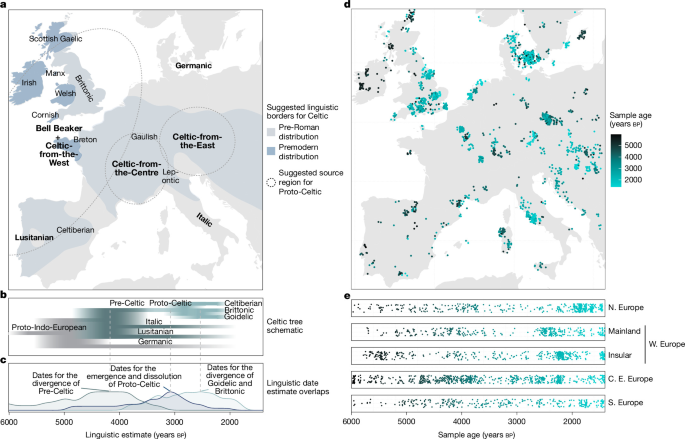
Europe’s present-day linguistic landscape is dominated by Romance, Germanic and Slavic languages, which expanded relatively recently during the Iron Age10,11,12,13. Before these events, Celtic languages were prominent across Europe1,2,3: Lepontic has been documented in northwestern Italy (2600–2100 bp), Celtiberian in central-northeastern Iberia (2200–1900 bp) and Gaulish across present-day France, central Europe, northern Italy and the Balkans (2500–1400 bp)14,15 (Fig. 1a). In the modern era, Celtic languages have retreated to the northwestern Atlantic fringe, where they persist as two groups: the Goidelic languages Irish, Manx and Scottish Gaelic; and the Brittonic languages Welsh, Cornish and Breton.
a, The four proposed source regions for the spread of the Celtic languages (circled) and the approximate pre-Roman and premodern distribution of Celtic languages from roughly 2000 bp (shaded). b, Tree schematic illustrating the position of Proto-Celtic relative to events that bound its emergence: the divergence of its predecessor (Pre-Celtic) from other Indo-European branches and the subsequent divergence into Brittonic and Goidelic (Insular Celtic). The tree structure and branch lengths are shown for illustrative purposes only and remain unresolved. c, Density plot showing the overlap of estimates for the divergence of Pre-Celtic (computational, quantitative), the emergence and dissolution of Proto-Celtic (archaeological and linguistic, qualitative) and the subsequent divergence of Goidelic and Brittonic (computational, quantitative). The linguistic studies from which the estimates come are depicted in Extended Data Fig. 1 and detailed in Supplementary Table 5.1. d,e, Geographical (d) and temporal (e) distributions of ancient samples included in the dataset that overlap with the region and timelines from a and c. In d, a small amount of jitter is added to the geographical coordinates. C. E., central-eastern; N., northern; S., southern; W., western. Base maps in a and d were generated in R (v.4.2.3) using map_data(“world”) in ggplot2 (v.3.5.0.9000); geographic boundary data are derived from the public-domain Natural Earth 1:50 m dataset (https://www.naturalearthdata.com) through the