// NATURE NEWS — SPAZIO & SCIENZA
Venousization enables angiogenesis in the absence of VEGFR signalling
Nature
(2026) Cite this article
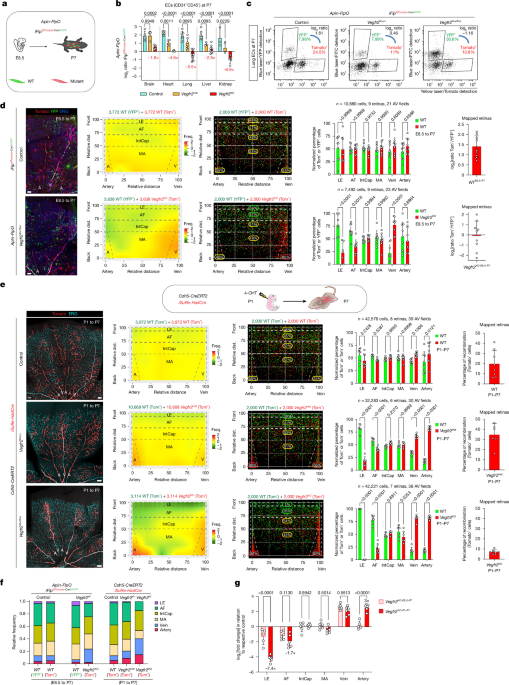
The vascular endothelial growth factor (VEGF) ligand and its main receptor VEGFR2 are considered to be essential for endothelial differentiation, proliferation, sprouting and survival1. Blood vessels cannot form in growing embryos or tissues when VEGF–VEGFR2 signalling is compromised in all cells2,3. The anti-VEGF antibody, which can block angiogenesis in cancer, wound healing or ischaemic diseases, is among the most widely used antibodies in the clinic. However, vascular resistance to anti-VEGF therapy has been reported4,5. Here we used iFlpMosaics and iSuRe–HadCre to induce and track genetic mosaics of endothelial cells (ECs) lacking VEGFR2 during the entire embryonic and postnatal development. These Vegfr2-knockout (Vegfr2KO) ECs adapted, proliferated normally and competed with wild-type cells over time, eventually forming a substantial portion of the vascular network in most organs. Vegfr2KO ECs could not sprout during the first wave of angiogenesis in most tissues, because this process is highly VEGF-dependent and favours growth and mobilization of wild-type ECs. However, owing to their inability to respond to VEGF, Vegfr2KO ECs became dominant in veins, which represented a long-term and continuous source of ECs for subsequent waves of VEGF-independent angiogenesis. Comparative single-cell RNA sequencing analysis of ECs with acute and long-term loss of VEGFR2 identified both common and organ-specific molecular mechanisms of adaptation and resistance to VEGF signalling loss. These included significant endothelial venousization and upregulation of ligands for VEGFR1 and VEGFR3. VEGFR1 only partially compensated for VEGFR2 loss in capillary ECs, whereas VEGFR3 compensated only in arterial ECs. Loss of the three VEGF receptors did not compromise venous growth. Notably, loss of the master regulator of venous development, NR2F2 (also known as COUP-TFII), significantly compromised expansion of Vegfr2KO ECs. This work has implications for our understanding of the role of VEGF receptors in angiogenesis and demonstrates venousization as a mechanism of adaptation and resistance to VEGF signalling loss during angiogenesis.
VEGF is frequently targeted in clinical settings to suppress tumour angiogenesis, metastasis and retina disease6. However, resistance to VEGF-blocking antibodies arises over time, which limits the effectiveness of such treatments4,5,7,8. By contrast, resistance to loss of VEGF signalling has not been reported during physiological vascular development.
Embryos or postnatal tissues lacking activity of the VEGF signalling pathway in all cells fail to develop vessels3. VEGFR2 (encoded by the Kdr (also known as Vegfr2) gene in mice) is the most important VEGF receptor and has been shown to be essential for angiogenesis in all vascular development contexts studied so far1,9. Germline mutants for this gene completely lack blood vessels and die very early during embryonic development2, and mouse embryos chimeras formed by wild-type and Vegfr2-knockout (Vegfr2KO) progenitor cells cannot form endothelial cells (ECs)10. Conditional deletion of Vegfr2 with Tie2–Cre after endothelial differentiation11, or in postnatal tissues with Cdh5–CreERT2, also strongly impairs angiogenesis12, without any evidence of genetic compensation or resistance.
Despite a large body of literature showing that VEGFR2 is essential for endothelial differentiation, proliferation, migration and survival, previous studies involving deletion of Vegfr2 in all ECs (Vegfr2iDEC) during embryonic or postnatal organ development could only analyse its effect on angiogenesis for a relatively short period of time. Its essential role in vascular development and hence in tissue development and organ function causes severe impairment of angiogenesis and premature lethality of Vegfr2iDEC embryos and postnatal animals; thus, such studies have been unable to determine whether ECs can adapt to loss of VEGFR2