// NATURE NEWS — SPAZIO & SCIENZA
Nectin-4 mediates rubella virus entry in airway and placental cells
Nature
(2026) Cite this article
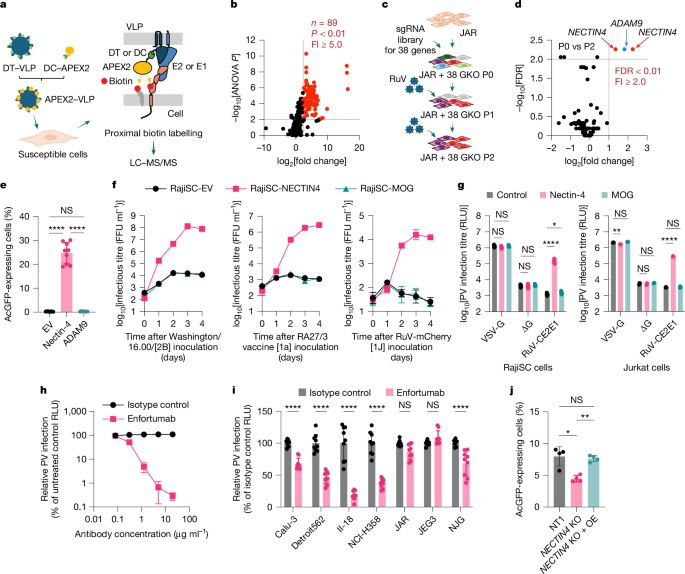
Rubella virus (RuV) causes rubella and, when acquired during pregnancy, congenital rubella syndrome1. Despite its clinical significance, the cellular entry mechanism of RuV remains poorly characterized, owing to limited identification of host receptors2, which hinders pathogenesis research and therapeutic development. Here, using proximity biotin labelling-based proteomics coupled with CRISPR–Cas9 validation, we identify nectin-4 as a functional RuV entry receptor. Ectopic expression of nectin-4 conferred susceptibility to RuV in non-permissive cells, whereas blocking or genetic ablation of nectin-4 reduced infection, results that demonstrate that nectin-4 is a major entry factor. Mechanistically, nectin-4 directly interacts with the RuV envelope glycoprotein heterodimer and facilitates receptor-mediated endocytosis following initial calcium-dependent viral attachment to cellular lipids. In polarized airway epithelial models, nectin-4 mediates basolateral entry of RuV and supports apical progeny release, a finding that provides a molecular mechanism for respiratory transmission. In placental models, nectin-4 is highly expressed on syncytiotrophoblasts and facilitates infection at the maternal–fetal interface, although additional nectin-4-independent pathways contribute to infection of other trophoblast populations. Together, these data establish nectin-4 as a key factor for respiratory transmission and early placental infection of RuV and highlight it as a promising therapeutic target for the prevention of rubella and related diseases.
This is a preview of subscription content, access via your institution
Access Nature and 54 other Nature Portfolio journals
Get Nature+, our best-value online-access subscription
Prices may be subject to local taxes which are calculated during checkout
The proteomics data have been deposited into the ProteomeXchange Consortium (identifier PXD067722; http://www.proteomexchange.org/) via the jPOST partner repository (JPST004036; https://jpostdb.org/)61. The FASTQ files for CRISPR–Cas9 screens have been deposited into the DNA Data Bank of Japan (accession number DRA022489). The statistical analysis data for the proteomics and CRISPR–Cas9 screens have been appended as Supplementary Tables. Gene expression data used for candidate selection were obtained from the Cancer Cell Line Encyclopedia (https://sites.broadinstitute.org/ccle). Subcellular localization data were obtained from the COMPARTMENTS database (https://compartments.jensenlab.org/). All other data supporting the findings of this study are available in the paper and its Supplementary Information. Source data are provided with this paper.
Hobman, T. C. Rubella Virus 7th edn (Wolters Kluwer, 2021).
Cong, H., Jiang, Y. & Tien, P. Identification of the myelin oligodendrocyte glycoprotein as a cellular receptor for rubella virus. J. Virol. 85, 11038–11047 (2011).
Article
PubMed
PubMed Central
CAS
Google Scholar