// NATURE NEWS — SPAZIO & SCIENZA
Aggression experience and observation drive shared behavioural and neural changes
Nature
(2026) Cite this article
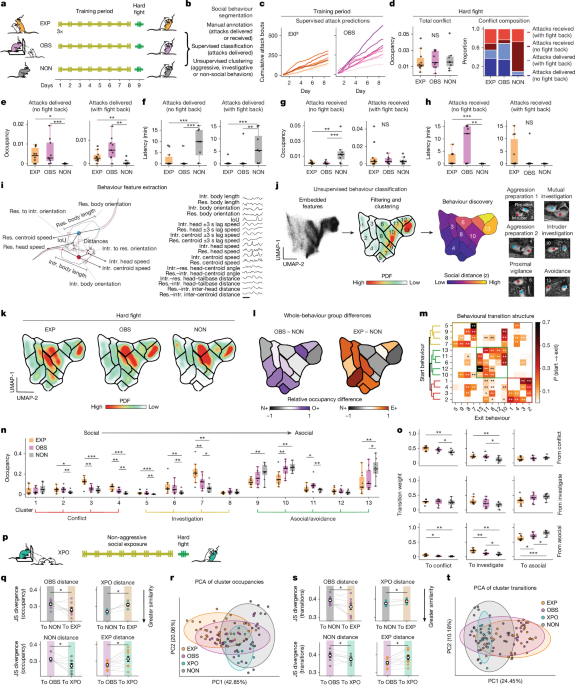
The ability to observe the social behaviour of others and use observed information to bias future action is a fundamental building block of social cognition1,2,3. Aggression observation activates hypothalamic neurons relevant for aggression control4,5, but whether observation and experience engage common circuit mechanisms that promote a new shared behavioural policy is unclear. Here we develop a strategy to perform large-scale cell-type-specific recordings across subcortical networks for social behaviour generation and learning. We record longitudinally while animals train through direct aggression experience or observation, then probe shared differences in behaviour and neural activity in a novel aggression context. After training, we detect unique signatures of a shared adaptive behavioural strategy that is absent in animals without training. During aggression observation, observed behaviour recruits widespread activation across subcortical networks for behavioural generation and mimics activity evoked by experienced behaviour, and shared neural changes persist into the novel aggression context. Multiregion modelling reveals shared changes to a core aggression network across both experience and observation, including a widespread reduction in inhibition, which we find is necessary for adaptive behavioural change. Together, this demonstrates that experience-like activity during aggression observation can recruit a shared inhibitory plasticity mechanism that biases behaviour toward adaptive proactive behavioural strategies.
A major open question is whether experience and observation modify behaviour through a shared neural mechanism to generate common adaptive behavioural strategies. Models of social learning posit that social behaviours, like other behaviours, can be acquired or refined as a result of either direct experience or observation2,3. Social observation may be particularly important when the costs of learning through direct experience are high, as in aggression.
Albert Bandura’s classic ‘Bobo doll’ experiments3, which demonstrated that children can learn aggressive behaviour through observation, highlighted that even behaviours that are considered part of an innate social repertoire can be highly influenced by social observation. In humans, exposure to violence is a risk factor that predicts an increased likelihood of future violence, suggesting that these effects can be long-lasting and generalize to new contexts6,7, but the underlying mechanism remains unclear. In animal models, chronic exposure to aggression has been shown to predict future aggression8. Moreover, in mice living in groups, where exposure to aggression is both frequent and behaviourally relevant, individuals attend to the fights of others and modulate their own aggression levels9,10. Previous work has identified a set of proactive behaviours, including self-defence and vigilance, that predict resilience and emerge through direct repeated aggressive social contact11,12. However, whether these adaptive behavioural strategies can also emerge after social observation and whether behavioural changes share a common neural mechanism is not known.
Behaviour ‘mirror’ neurons have been described in cortical structures across a variety of species13, and recent evidence has shown that neurons in a key hypothalamic area for aggression14 (the ventromedial hypothalamus, ventrolateral area, VMHvl) can also be recruited during vicarious observation of aggression4,5. However, whether this property is widespread within larger subcortical networks for social behaviour generation and whether this activity is critical for updating future behaviour in novel contexts is unclear. The social behaviour network (SBN) is a highly conserved network of largely subcortical brain regions (hypothalamus, amygdala and midbrain) that is conserved across vertebrates15. The SBN is highly interconnected, with many key regi