// NATURE NEWS — SPAZIO & SCIENZA
The deep Earth origin of the Great Unconformity
Nature
volume 659, pages 106–112 (2026) Cite this article
The Great Unconformity marks a globally extensive erosive surface linked to climatic shifts1 and environmental transitions2 that preceded the Cambrian explosion of life. The processes proposed to explain the formation of the Great Unconformity include glacial erosion during the Snowball Earth1,3,4, rifting and plume activity5,6,7, sea-level fall8 and mantle-driven dynamic topography6,9,10,11. However, the dynamics of these processes have not been tested. Here we show that continental-scale uplift and subsidence associated with long-wavelength dynamic topography12 due to mantle convection drove the formation and preservation of the Great Unconformity. Our models predict prolonged continental-scale Neoproterozoic uplift and long-term Phanerozoic subsidence for Laurentia, Baltica and North China. This vertical motion scenario is ideal for the formation and preservation of the Great Unconformity, which is a first-order surface expression of deep Earth processes. The predicted prolonged continental uplift throughout Cryogenian times would have resulted in marked erosion due to the action of glaciers13. The large area of Laurentia and limited deformation at its margins explain why the Great Unconformity is best preserved and documented there. Our models predict cycles of dynamic topography that are broadly reflected in preserved sediment volume across continents1,14, and open new avenues for understanding the environments of Cambrian animal diversification.
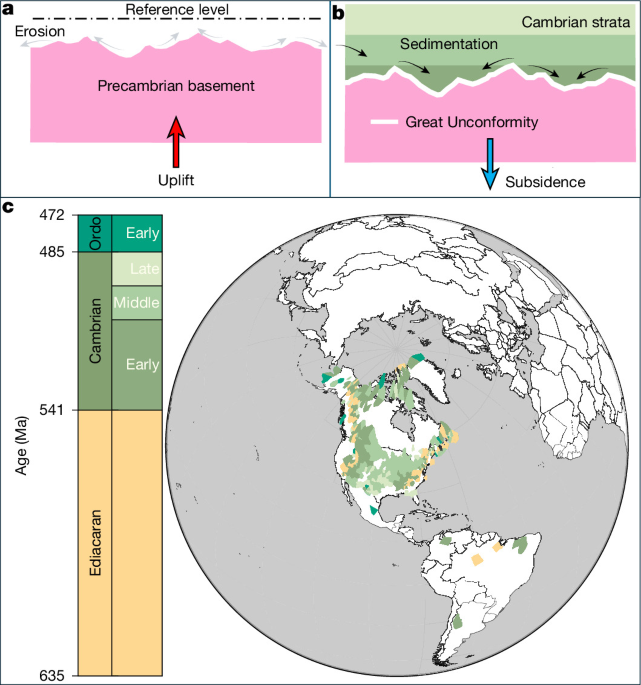
An unconformity is a surface that represents a temporal gap (hiatus) in the geologic record in which younger sediments are deposited over older rocks, after a period of erosion or non-deposition15. Although unconformities are common in the rock record, they markedly vary in spatial extent and hiatus duration. The largest known unconformity is called the Great Unconformity16. It represents an erosional or non-depositional hiatus lasting about 200 million years (Myr) or longer, and marks the onset of sedimentation at the start of Phanerozoic time and of the Cambrian explosion of life2. The Great Unconformity was first described in the Grand Canyon17, and has been established across North America from a digital database of sedimentary deposits1,2,9 and thermochronological data3,4,6,7,10,18. The oldest sediments at the base of the Great Unconformity in North America are between 635 Myr old and 482 Myr old (Ediacaran to Early Ordovician times; Fig. 1). Spatially extensive unconformities of a similar age have been documented in Baltica19,20,21,22,23,24 and in North China8,25,26,27,28. The global sedimentary volume estimated from geologic maps and borehole data more than doubled across the Precambrian–Phanerozoic boundary1,14.
a,b, The Great Unconformity was formed by continental-scale erosion of Precambrian crystalline basement (a) followed by Cambrian sedimentation (b). In b, the sedimentary strata are coloured by age and the white line represents the Great Unconformity surface. The schematics in a and b are not to scale. c, Spatial distribution of the oldest sedimentary strata deposited between Late Ediacaran and Early Ordovician (Ordo) times in the database Macrostrat55, coloured by age. Lambert azimuthal equal-area projection at the surface of Earth.
The cause or causes of the Great Unconformity are unknown. The proposed mechanisms include extensive glacial erosion during Snowball Earth (about 720–635 Myr ago or Ma)1,3,4, rifting and plume activity5,6,7, sea-level fall8 and mantle-driven dynamic topography6,9,10,11. These processes have not been dynamically tested, with limited comparison between global models and global datasets to explain the spatial distribution of the Great Unconformity. Here, we propose that continental-scale dynamic topography6,9,10,11,12,29,30, which is transient over thousands of kilometres and tens of millions of years12, provided the driving force for surface process