// NATURE NEWS — SPAZIO & SCIENZA
An open structure-guided RNA foundation model for generalizable prediction
Nature
(2026) Cite this article
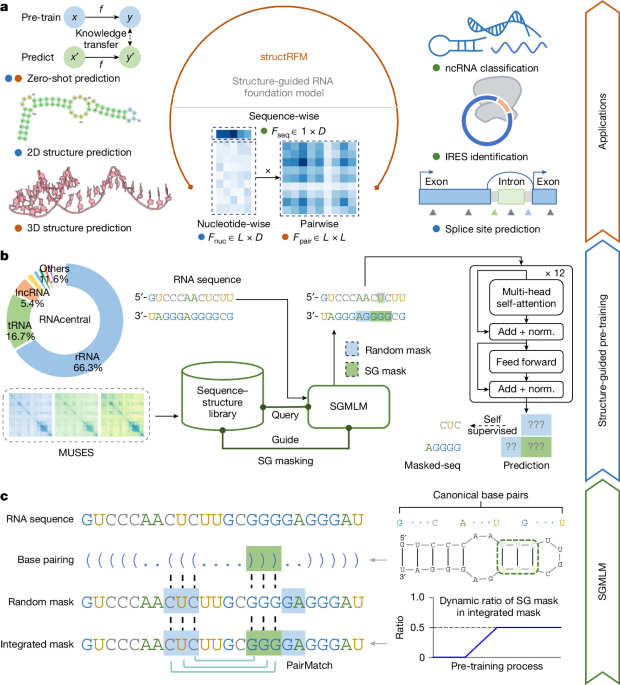
RNA language models have achieved strong performance across diverse downstream tasks by leveraging large-scale sequence data. However, RNA function is fundamentally shaped by hierarchical structure, making structural information important for pre-training. Existing approaches often depend on noisy annotations or task-specific objectives that can limit generalizability. Here we present structRFM, a structure-guided RNA foundation model trained on 21 million RNA sequence–structure pairs by integrating base-pairing interactions into masked language modelling through a pair-matching operation. We also introduce MUSES, a multi-source ensemble of secondary structures designed to mitigate predictor bias, and a dynamic masking ratio that balances structure-guided and nucleotide-level masking. structRFM learns joint sequence and structure representations as sequence-level, nucleotide-level and pairwise features for broad downstream adaptation. It ranks highly in zero-shot homology classification and establishes new benchmarks for secondary-structure prediction. Its tertiary-structure adaptation, Zfold, consistently improves both three-dimensional predictions and their extracted secondary structures, with performance comparable to AlphaFold31 across CASP15-natural, CASP16 and RNA-Puzzles. structRFM also improves performance on function-prediction tasks and generalizes to newly released RNA families and long non-coding RNAs. Together, these results demonstrate the effectiveness of structure-guided pre-training and highlight multimodal RNA language models for robust structural and functional inference. The complete 21-million-pair dataset, model weights and source code are openly available to support multimodal RNA foundation-model development.
This is a preview of subscription content, access via your institution
Access Nature and 54 other Nature Portfolio journals
Get Nature+, our best-value online-access subscription
Prices may be subject to local taxes which are calculated during checkout
The structRFM pre-training sequence–structure dataset is publicly available at Zenodo (https://doi.org/10.5281/zenodo.18272040 (ref. 77)) and pre-trained model and fine-tuned model checkpoints are publicly available at GitHub (https://github.com/heqin-zhu/structRFM). The training and test datasets are publicly available at GitHub (https://github.com/heqin-zhu/structRFM), which are from the following sources: RNAcentral v24.041: https://ftp.ebi.ac.uk/pub/databases/RNAcentral/releases/24.0/; Rfam v14.1066,67: https://ftp.ebi.ac.uk/pub/databases/Rfam/14.10/and Rfam v15.0: https://ftp.ebi.ac.uk/pub/databases/Rfam/15.0/; ArchiveII600 and ArchiveII37: https://rna.urmc.rochester.edu/publications.html; RNAStrAlign35: https://github.com/mxfold/mxfold2/releases/tag/v0.1.0; bpRNA-1m, bpRNA-TR0 and bpRNA-TS036: https://bprna.cgrb.oregonstate.edu/download.php#bpRNA; PDB46,47: https://www.rcsb.org/; CASP1527: https://predictioncenter.org/download_area/CASP15; CASP1628: https://predictioncenter.org/download_area/CASP16; RNA-Puzzles48: https://www.rnapuzzles.org/puzzles/list/; SpliceAI4: https://github.com/Illumina/SpliceAI; IRES29,30: Gene Expression Omnibus (GEO) accessions GSE74277 and GSE178718; nRC31: http://tblab.pa.icar.cnr.it/public/nRC/paper_dataset/; lncRNA-Human (GENCODE 2021)56: https://www.gencodegenes.org/human/; lncRNA-Mouse (GENCODE 2021)56: https://www.gencodegenes.org/mouse/; and the NCBI nucleotide (nt) database42: https://ftp.ncbi.nlm.nih.gov/blast/db/. The study-specific processed IRES split and source data underlying the figures are provided with this paper. All other data are available within the article and its Supplementary Information. No restrictions apply. Source data are provided with this paper.
The source code of structRFM is publicly available at Zenodo (https://doi.org/10.5281/zenodo.18274292 (ref. 78)) and GitHub (https://github.com/heqin-zhu/structRFM).
Abramson,