// NATURE NEWS — SPAZIO & SCIENZA
Synergy in viral–bacterial co-infection expedites algal bloom demise
Nature
(2026) Cite this article
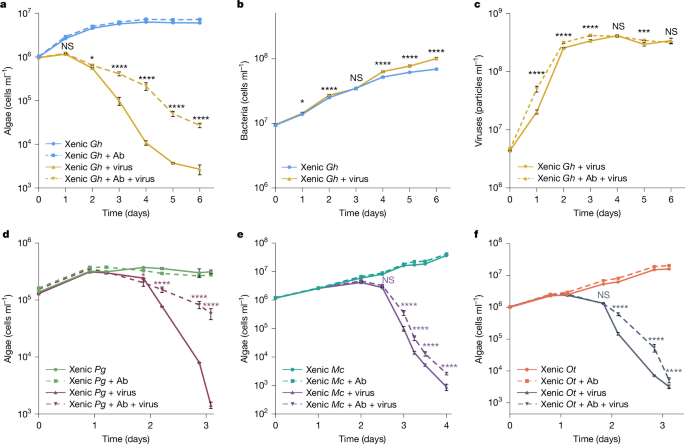
Algal bloom demise, often caused by viruses, is a major driver of carbon cycling in the surface ocean1,2. However, although blooms collapse synchronously, fewer than 30% of algal cells are actively infected by viruses3, indicating the involvement of additional mortality agents. Here we quantified tripartite interactions within a synthetic community composed of the abundant coccolithophore Gephyrocapsa huxleyi, bacteria and viruses isolated during a bloom. We found that bacteria significantly enhanced virus-induced algal mortality in G. huxleyi as well as in three other globally widespread microalgae. We quantified this interaction using two new metrics: the synergy index, which measures viral–bacterial interaction strength, and the benefit index, which assesses changes in bacterial fitness. We identified Alteromonas bacteria as drivers of viral–bacterial co-infection, with consistently high synergy index and benefit index. We found that during algal blooms, Alteromonas displayed high chemoattraction towards infected cell extracts, accumulated in aggregates derived from bloom demise, and increased in abundance during oceanic bloom collapse. Viral–bacterial synergy represents a previously unrecognized mortality agent that controls bloom termination, modulating the balance between the carbon-recycling viral shunt and the carbon-exporting viral shuttle pathways, which influence global carbon cycling4,5,6.
About 50 gigatons of carbon are fixed annually by marine phototrophs, feeding the entire microbial food web7,8,9. A substantial portion of this carbon fixation occurs during large-scale algal blooms1,10. Therefore, microbial processes that control cell fate in these blooms can have profound effects on marine carbon cycling11. Algal blooms are hotspots for diverse interactions and metabolic exchange with grazers, bacteria, fungi and viruses12,13. Marine viruses, the most abundant biological entities in the ocean, are major mortality agents, driving nutrient cycling globally and significantly impacting algal bloom demise2,14,15.
Viruses regulate the fate of carbon and other nutrients16 through two distinct ecosystem processes: the viral shunt4,5, which fuels the microbial food web by catalysing nutrient recycling in the surface ocean; and the viral shuttle5,6, which facilitates carbon export through enhanced aggregation of lysed cells and sinking of particulate organic matter in the oligotrophic ocean17 and during algal blooms18. Viral lysis of algal populations creates a distinct metabolic footprint19,20,21, which can promote the growth of adapted heterotrophs22, thereby altering microbial biodiversity23,24. Yet, how virus-induced shifts in microbial community composition influence algal cell fate—and thus global carbon cycling—remains poorly understood.
We selected G. huxleyi (previously known as Emiliania huxleyi) to study algae–virus–bacteria interactions owing to its ecological significance in marine ecosystems. This cosmopolitan unicellular eukaryotic alga forms extensive blooms, covering thousands of square kilometers25. It has a crucial role in global carbon and sulfur biogeochemical cycles due to its carbon fixation, its calcite exoskeleton production, and the release of sulfur volatiles such as dimethyl sulfide25,26,27. These blooms are often terminated following infection by a giant double-stranded DNA (dsDNA) virus, the Emiliania huxleyi virus (EhV)28. Despite the observed synchronized collapse of entire blooms29, quantification of active viral infection using single-cell approaches revealed a discrepancy: fewer than 30% of algal cells were infected by the virus during the bloom’s demise3,30. This suggests that additional mortality agents may act together with viral infection. Inspired by findings from the biomedical field demonstrating that viral–bacterial co-infections synergistically increase mortality31,32, we investigated the interplay between bacteri