// NATURE NEWS — SPAZIO & SCIENZA
A conserved flowering-time module underlies double-season cropping
Nature
(2026) Cite this article
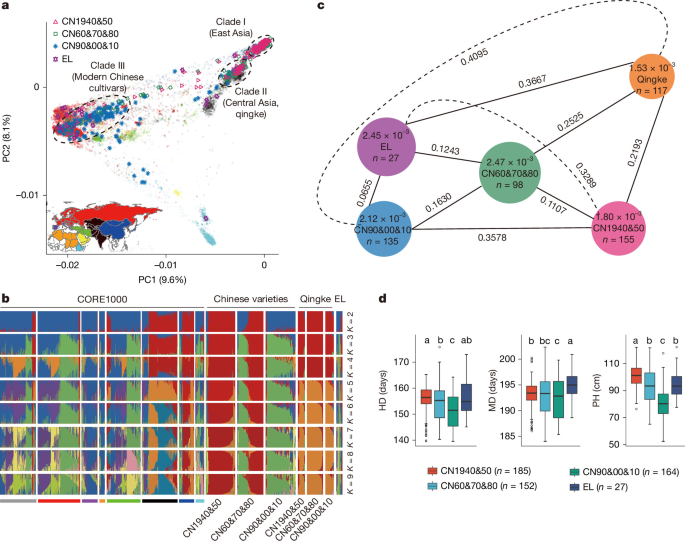
Adapting crops to intensive cultivation systems under climate change requires varieties that combine yield potential with optimized flowering and maturation1,2. In central and eastern China, barley has long been cultivated in a double-season cropping system, in which early flowering and maturation are critical for escaping presummer terminal heat stress and enabling flexible rotation with summer crops3,4. Here we trace the genomic footprints of 80 years of modern breeding in China using 505 representative cultivars and identify a flowering-time module defined by a single amino acid substitution in PHYTOCHROME C in combination with a winter-type VERNALIZATION 1 haplotype that underpins this adaptation. The derived allele accelerates heading and maturity, and its frequency has risen sharply in modern autumn-sown varieties. Using base editing in barley and wheat, we confirm causality and demonstrate that this flowering-time combination module, PhyC–VRN1, is functionally conserved across Triticeae. Our results identify and experimentally validate a breeding-relevant flowering-time module that has been selected during modern breeding to enable intensive crop rotations, as well as demonstrate how precision genome editing can be used to reconstruct such adaptive modules for climate-resilient crop design.
This is a preview of subscription content, access via your institution
Access Nature and 54 other Nature Portfolio journals
Get Nature+, our best-value online-access subscription
Prices may be subject to local taxes which are calculated during checkout
Sequence data for 510 accessions generated in this study have been deposited at the China National Center for Bioinformation under BioProject ID PRJCA049684. Sequence data for an extra 22 accessions were obtained from the National Center for Biotechnology Information (NCBI) under BioProject ID PRJNA417220. Accession codes for all individual accessions are listed in Supplementary Table 2. The NCBI non-redundant protein database (nr) version 4 was used for protein sequence annotation (https://ftp.ncbi.nih.gov/blast/db/v4/). Source data are provided with this paper.
The shell and Perl scripts used in this study are available at GitHub (https://github.com/guoyu-meng/barley-haplotype-script). Further in-house Perl and shell scripts for read mapping, variant calling, filtering and annotation, and population genetic analyses are available at SourceForge (https://sourceforge.net/projects/origin-of-qingke-barley/files/).
Dawson, I. K. et al. Barley: a translational model for adaptation to climate change. New Phytol. 206, 913–931 https://doi.org/10.1111/nph.13266 (2015).
Article
PubMed
Google Scholar