// NATURE NEWS — SPAZIO & SCIENZA
Microbiome-wide PheWAS links gut microbial SNVs to health and exposures
Nature
(2026) Cite this article
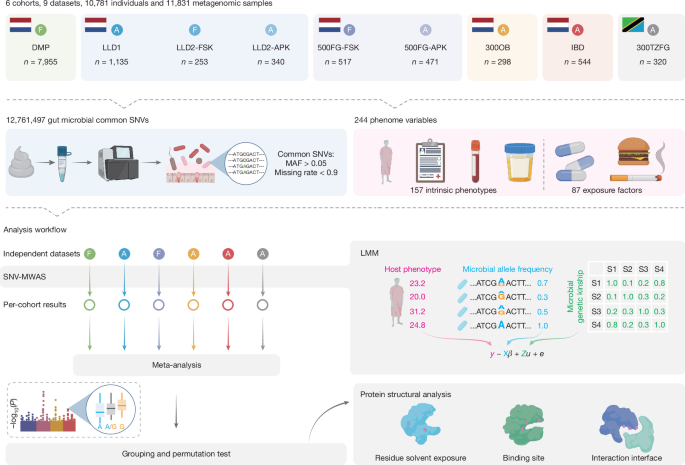
Alterations in the microbial composition of the human gut have been associated with a wide range of chronic diseases1,2. Yet species-level composition alone can obscure extensive within-species genetic diversity and functional variation. This has driven a shift towards strain-resolved, genetic-level analysis of the microbiome, leveraging microbial genetic variation to identify disease-relevant genes and pathways3,4,5,6. Here we conducted a phenome-wide association study (PheWAS) analysing 12.8 million gut microbial single-nucleotide variants (SNVs) with 244 host health phenotypes and environmental exposures in 10,781 individuals from 6 independent cohorts. We identify 940 independent associations across 69 host factors, including age, sex and cardiovascular and metabolic parameters. Structural analyses identified host-phenotype-associated SNVs in functionally important regions of proteins, findings that inform mechanistic hypotheses about how microbial genetic changes relate to environmental and host physiological factors. For example, we identified an age-associated SNV in Faecalibacterium prausnitzii that affects an amino acid within the protein pocket that binds glutathione. To support future efforts, all study summary statistics are provided in an online catalogue (https://fulab.web.rug.nl/SNV-MWAS/). Together, these results identify new biological connections between the human host and microbial genetic variants at base pair resolution and provide a resource for hypothesis generation that will aid future understanding of the strain-level functionality of the gut microbiota.
The gut microbiome exhibits large variations in its composition and genetic landscape. Within-species genetic variation underlies strain differences in fitness, metabolic capacities, pathogenicity and other biological properties. Thus, the field of microbiome research is moving towards strain-level or genetic-level dissection of the microbial contributions to human health (Supplementary Information). Structural variations in the gut microbiome have been linked to human body mass index (BMI), bile acid concentrations, the human plasma metabolome and host genetics, thereby identifying bacterial genes involved in glucose metabolism, bile acid biosynthesis and biotransformation, and N-acetylgalactosamine utilization3,4,5,6.
However, gut microbial genomes also contain abundant SNVs that can modulate microbial function and host interactions. For example, a SNV in the blc gene of Escherichia coli disrupts the intestinal barrier by decreasing the amount of lysophosphatidylethanolamine, a metabolite that aids remission of inflammatory bowel disease7. In the stomach, a SNV in Helicobacter pylori increases gastric cancer risk by enhancing the proteolytic activity of the serine protease HtrA (ref. 8). In Bacteroides coprocola, SNVs in glycosyl hydrolase genes have been associated with type 2 diabetes9. A SNV-based metagenome-wide association study (SNV-MWAS) in an Israeli population identified BMI-associated SNVs that were replicated in a geographically independent Dutch cohort10. Despite these examples, systematic explorations of the relationships between gut microbial SNVs and host phenotypes have not, to our knowledge, been carried out at phenome-wide scale. Such analyses require large-scale human cohort data with both metagenomic and deep phenotypic data, and they need to overcome a number of technical challenges. For example, microbial species exhibit complex population genetic structures, and these strong lineage effects may lead to false discoveries in association studies if population structure is not properly controlled.
In this study, we compiled shotgun metagenomic sequencing data of 11,831 faecal samples from 5 independent cohorts from the Netherlands and a cohort from Tanzania. Gut microbial genotypes were characterized using GT-Pro11, yielding 12.8 million SNVs in core genomic regions.