// NATURE NEWS — SPAZIO & SCIENZA
A spatiotemporal cancer cell trajectory underlies glioblastoma heterogeneity
Nature
(2026) Cite this article
Cancer cells show highly heterogeneous and plastic states in glioblastoma, an incurable brain tumour1,2,3,4,5. However, how these malignant states arise and whether they follow defined cellular trajectories across tumours is poorly understood. Here we generated a deep single-cell and spatial multi-omic atlas of human glioblastoma that pairs transcriptomic, epigenomic and genomic profiling of 12 tumours across many regions. We identify that glioblastoma heterogeneity is driven by spatially patterned transitions of cancer cells from developmental-like states towards those defined by a glial injury response and hypoxia. This cellular trajectory regionalizes tumours into distinct tissue microenvironments and manifests in a molecularly conserved manner across tumours as well as genetically distinct tumour subclones. Consistently, using a new deep-learning framework to map cancer cell states jointly with clones in situ, we show that tumour subclones are finely spatially intermixed through glioblastoma tissue microenvironments. We validate this cellular trajectory by using somatic mutation-based hierarchies in vivo and an experimental patient-derived organoid model ex vivo. Finally, we show that this cancer cell trajectory is intimately linked to myeloid heterogeneity and unfolds across regionalized myeloid signalling environments. Our findings define a stereotyped trajectory of cancer cells in glioblastoma and unify glioblastoma tumour heterogeneity into a tractable cellular and tissue framework.
The extensive tumour heterogeneity of glioblastoma (GB), an incurable adult brain cancer, presents a major obstacle to treatment. Nearly two decades of molecular profiling has found that malignant cells exist across a spectrum of cellular states within each tumour, resembling developmental neural progenitors as well as mesenchymal-like and injury response states1,2,3,4,5. These states are suggested to vary in abundance across tumours and stratify GBs into subtypes1,2. Furthermore, patient-derived xenografts have shown that malignant cells can transition across cellular states, indicating their plasticity2,6. Despite these extensive efforts, we still do not understand how cancer cells diversify into distinct states and give rise to GB heterogeneity. In particular, whether malignant cells follow stereotyped or variable cellular trajectories across GB tumours is unknown. A cancer cell trajectory that is conserved and tractable across GBs would present a highly attractive therapeutic target.
Single-cell, bulk and spatial genomics have revealed stereotypical aspects of GBs. Several malignant cell states can be detected within each tumour2,5,7 and their single-cell transcriptional profiles can be mapped onto an axis between developmental-like (dev-like) and injury response-associated gene expression programs4,8. Genetic heterogeneity1,2 and tumour microenvironment (TME) signals9 also influence malignant cell state identity. Furthermore, these states show a recurrent spatial organization across tumours5,10. Yet, these observations have not been linked together to resolve malignant cellular trajectories in GB, in part due to the lack of multimodal profiling efforts that can integrate insights from various cell and tissue atlassing technologies. Here we address this challenge by means of deep single-cell and spatial multi-omic profiling of human GBs and identify that a stereotyped spatiotemporal trajectory of cancer cells gives rise to GB heterogeneity.
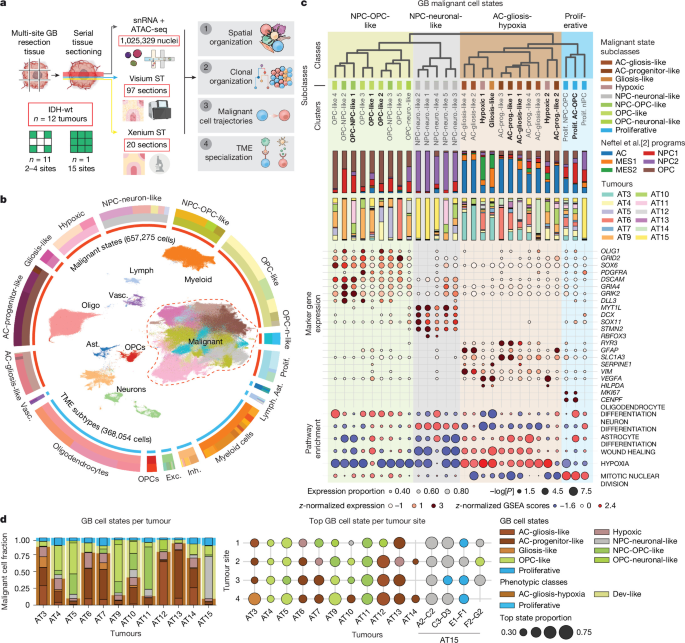
To comprehensively profile GB heterogeneity, we generated a single-cell and spatial multi-omic atlas of 12 isocitrate dehydrogenase wild-type (IDH-wt) primary GB tumours (Fig. 1a and Supplementary Table 1), combining three main approaches. First, we profiled each tumour across many sites, ranging from 4 sites (roughly 1.25 cm3 each) for most cases to 15 sites effectively covering one whole tumour (Extended Data Fig. 1a and Supplementary