// NATURE NEWS — SPAZIO & SCIENZA
Imaging exoplanets below the telescope stability limit
Nature
volume 659, pages 58–62 (2026) Cite this article
Exoplanet imaging is the main method for detailed characterization of planets orbiting beyond 1 au (ref. 1) but it requires suppressing the bright glare of the star to see the faint planet light. As well as sophisticated instrumentation2,3, effective image processing is necessary for starlight suppression, which continues to be a substantial limitation4. Standard algorithms use reference images for starlight modelling and thus they are limited by inevitable telescope instabilities that change from reference to science observation5,6. Addressing this challenge will increase the number of planets amenable to direct imaging and will be a notable step towards imaging exo-Earths with future observatories7. Here we present a new physics-based method for starlight subtraction. Our method combines a multistep optimization with a flexible physical model to produce a starlight model, allowing modelling and compensation of instrument instabilities. We use automatic differentiation (autodiff)8 to optimize millions of model parameters. We demonstrate our method on observations from the James Webb Space Telescope (JWST) Near-InfraRed Camera (NIRCam)9,10,11 coronagraph instrument. We achieve sensitivity 2–15 times superior to standard techniques, including the first detection of 51 Eridani b (ref. 12) at 4.3 μm. This is the first time, to our knowledge, that such an approach has demonstrated substantially improved sensitivity on real, on-sky coronagraphic imaging. Our framework can be extended to other current and future ground-based and space-based observatories, including the Nancy Grace Roman Space Telescope and the Habitable Worlds Observatory (HWO), potentially relaxing the unprecedented stability requirements needed to make these a success.
To detect any planetary signals by direct imaging, the glare of the star (or stellar point spread function (PSF)) must be modelled and removed from our observations. Because even the brightest young giant planets are about 105 times fainter than their host stars in the near-infrared, modelling the stellar PSF to the required precision is difficult. This is because of its strong dependence on factors such as stellar properties and instrumental aberrations. Until now, the most successful approaches build the PSF model empirically using a library of reference observations taken at other times or wavelengths or of other stars (for example, refs. 13,14).
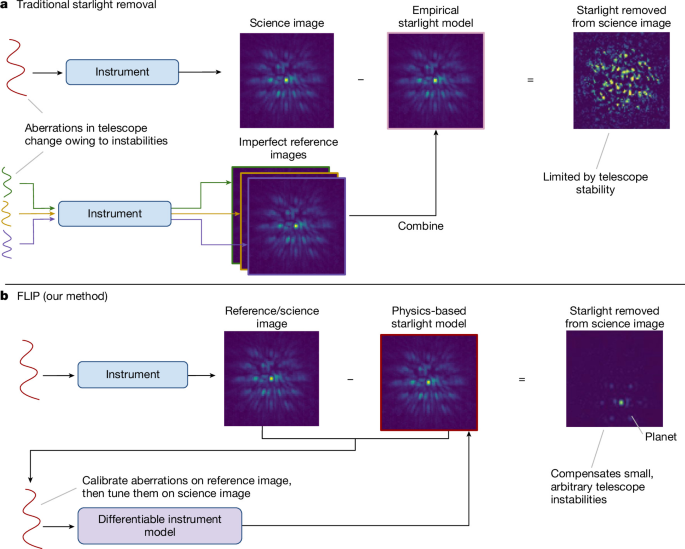
However, these empirical approaches are fundamentally limited by various sources of instabilities (Fig. 1). In space-based observatories, these mostly include telescope pointing errors and thermal drifts6, causing differences between reference and science PSFs and reducing our sensitivity6,15. Advances in PSF modelling that do not rely as heavily on observatory stability could have transformative implications for exoplanet imaging, for both current and future observatories. For example, one of the main challenges for future missions such as the HWO, with the ambitious goal of imaging Earth analogues around Sun-like stars (1010 brightness contrast), is achieving an extreme and unprecedented stability at the picometre level (100 to 1,000 times more stable than the JWST5,16).
a, Standard starlight subtraction. b, Our method based on FLIP. The stellar PSF is shaped by inevitable and imperfectly known aberrations in the telescope (including star–coronagraph misalignment and optical phase aberrations, represented by coloured curves to the left of the diagrams). Starlight subtraction methods based on empirical reference images are limited by telescope instabilities that cause changes in these aberrations, as these result in dissimilar reference PSFs (symbolized with curves and image outlines of different colours) and thus imperfect PSF subtraction when combining them into an empirical PSF model. Our method, FLIP, pre-calibrates an instrument model on reference images to repr