// ENGADGET — MODA & SOCIETÀ
HoverAir Versa review: Convenience and creativity with compromises
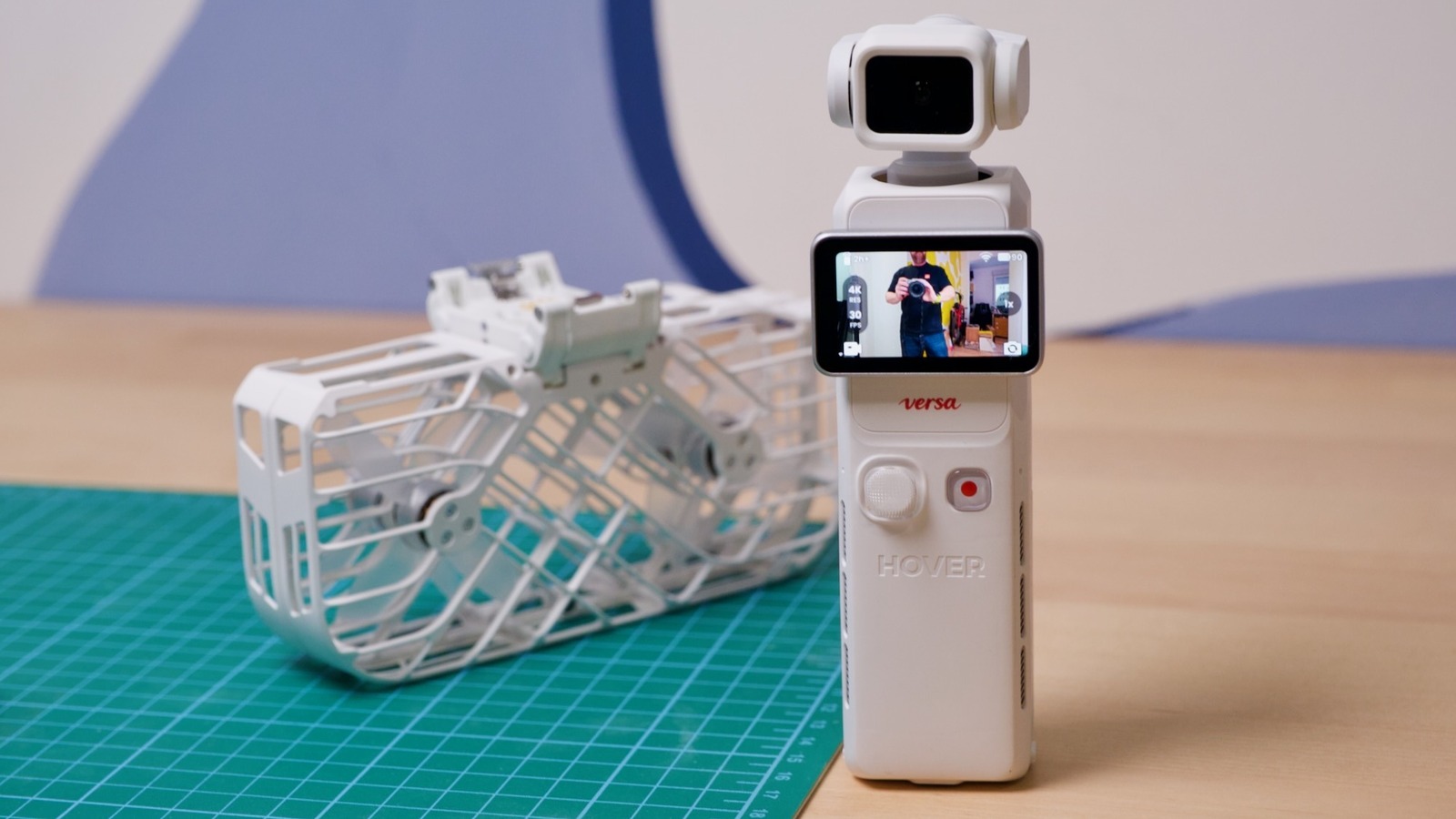
The device is a clever combination that makes a lot of sense, but don’t expect the best of both worlds.
Calling a drone a "flying camera" is a bit like calling a small plane a "flying car." If your only option is to fly it, it's just a drone. But what if it was an actual camera, that could also fly? Enter the HoverAir Versa ($539), which is exactly that.
The Versa is a handheld gimbal camera similar to DJI's Pocket 4 or the Insta360 Luna Pro. Snap on a magnetic accessory, though, and it becomes a mini drone or... a flying camera.
HoverAir isn't new to the game, with its debut Passport selfie drone launching over 10 years ago. The Versa is the company's first stab at a handheld camera though, and there's already a small speed bump. Due to an FCC take-backsie, the Versa's US availability is unclear. The handheld camera could be available at some point, but the drone feature is causing the same legal tangles that cleared shelves of DJI products in the US. Most of the rest of the world, including Canada (and thus eBay resellers no doubt), will have access to the full kit.
The 2-in1 is an intuitive idea, but it does raise some questions. Are there compromises in either mode? Can a company far smaller than DJI beat them at their own game? A couple of weeks with the Versa revealed a surprising answer.
First and foremost, the Versa is a camera. It has a max resolution of 4K/60 fps combined with a 1/1.3-inch sensor. That puts it somewhere between the Pocket 4 (1-inch) and the Neo 2 (½-inch) in terms of pixel size and low-light performance. The camera has 2x (in-sensor) zoom, will support H-Log in a future update and includes a 10-bit HDR mode. The gimbal is 3-axis, the same as its handheld rivals from DJI and Insta360, but one more axis than the Neo 2 — which is DJI's most comparable drone right now. HoverAir claims the Versa has 17.5 stops of dynamic range, which was one of the main selling points of DJI's pricier Osmo Pocket 4P, though photos are limited to 12 megapixels. There's 55GB of available internal storage, expandable by SD card.
Of course, the Versa is more than just a gimbal camera, and its ability to pull double duty comes with a notable perk. In drone mode, the Versa has swappable batteries. That's essential for a drone, but pretty rare for a handheld gimbal camera.
Pop the propellers on and, instead of the usual preview on the 1.64-inch screen, you'll see a menu to switch between a set of preset flight patterns. The drone has downward sensors for maintaining position and palm takeoff/landing, but there's zero obstacle avoidance. In follow mode, it uses software smarts to track your path from behind. If it's in front of you, though, things are a little more dicey as it'll track you via the camera but has no idea what's behind it.
The Versa's design in handheld mode is pretty boxy. I'm going to assume this comes down to aerodynamics, as it's not particularly stylish. The 1.64-inch display is practical but noticeably cramped if you're used to either the Osmo Pocket 4 or the Luna Pro's larger 2-inch screens.
HoverAir states that the Versa has a 19mm equivalent lens with an f2.0 aperture. That's similar to the Luna Pro (f1.8/20mm) and Osmo Pocket 4 (f2.0/20mm), but that 1mm makes all the difference as the Versa shoots noticeably wider. There's also an ultra-wide mode for a more "action-cam" style point of view. The 2x zoom is functional and adds some flexibility to your shot options, but there's no smooth zoom in or out. It's 1x zoom or 2x and nothing in between.