// SPACE.COM — SPAZIO & SCIENZA
Uranus has a weird magnetic field that's stumped scientists for 40 years — we may finally know why
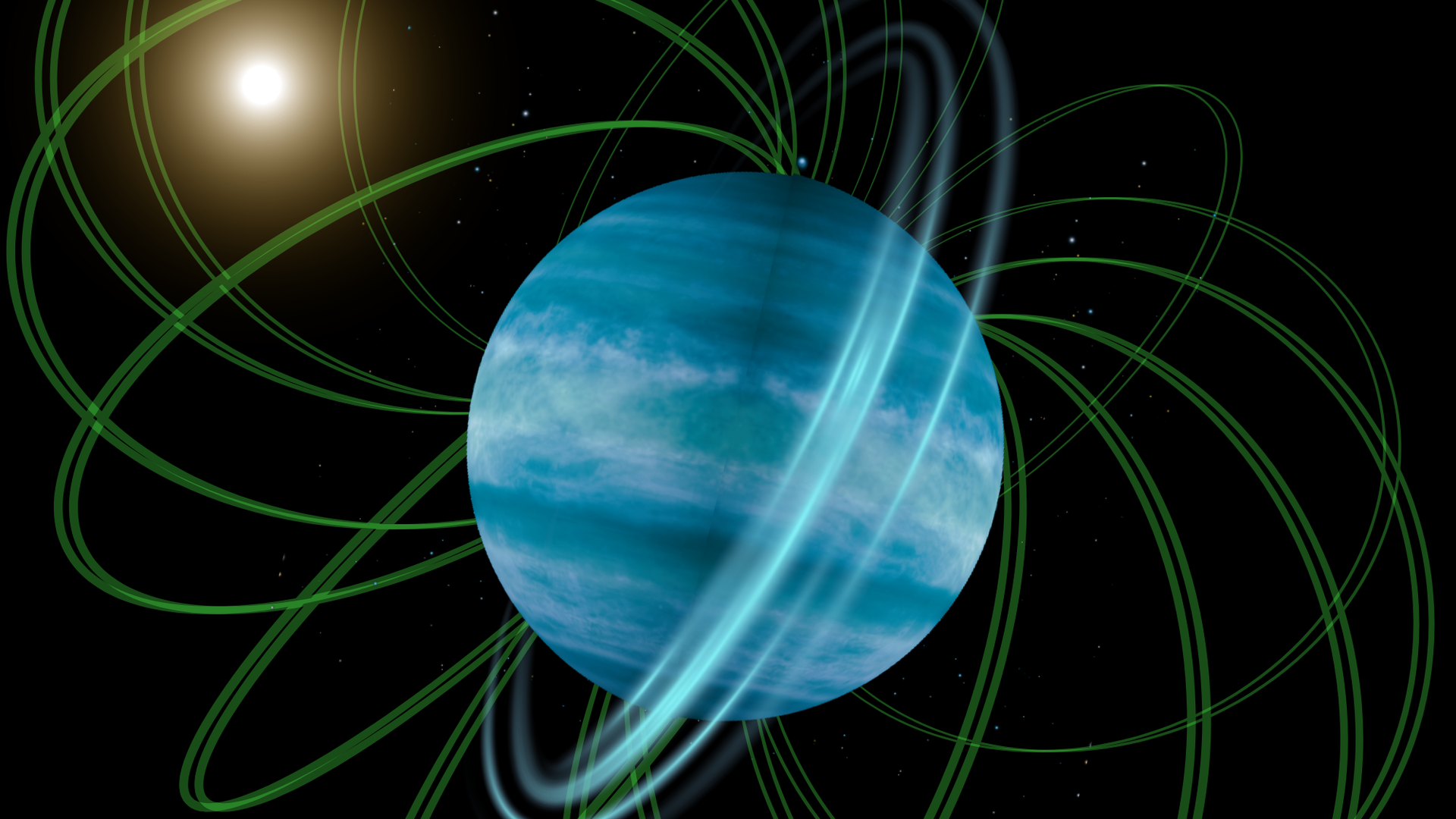
The ice giants' skewed magnetic fields are a window into the high-pressure, high-temperature environment deep inside Uranus and Neptune.
When you purchase through links on our site, we may earn an affiliate commission. Here’s how it works.
The posided magnetic fields of Uranus and Neptune may stem from extreme conditions lying within their deep interior. Unravelling the mystery behind the magnetic fields of these worlds is giving us new insight into the little-known interiors of the ice giants.
Only one spacecraft has ever visited Uranus and Neptune, the Voyager 2 spacecraft which spend past Uranus in January 1986 and Neptune in August 1989. Voyager 2 found that their planetary magnetic fields were, to put it bluntly, wonky. Uranus’ magnetic field was offset from its rotational axis by 59 degrees and isn’t even centered on the planet’s core, but instead is only two-thirds of the way down. Neptune is similar, with a disordered magnetic field offset by 47 degrees and centered halfway between the core and its visible cloud tops.If we compare these planets to Earth, which has a stable magnetic field tilted by just 11 degrees to our planet’s rotation, we can see how extreme the magnetic fields of the ice giants are.
Various explanations for the strange magnetic fields of the ice giants have been put forward over the years. Uranus as a whole is tilted by 97 degrees and effectively rolls around the sun, and speculation is that billions of years ago it was knocked on its side by a collision with a long-lost Earth-sized planet. Could this collision have also skewed its magnetic field?
This might be a plausible explanation were Neptune’s magnetic field also not similarly skewed without having experienced a collision. Clearly, whatever the cause, it must be intrinsic to the nature of the two ice giant planets. Now, a new study by scientists in the U.S. and the UK, based on computer simulations and Voyager 2’s measurements of the two planets’ magnetic fields, may have found a solution.
The solution to the weird magnetic fields of the solar system's ice giants may come down to how planets generate their magnetic field through the dynamo effect. This arises from the swirling, convective motion of an electrically conducting liquid within a rotating body, which is able to generate and maintain a powerful magnetic field.
Inside Earth, the electrically conducting fluid is the molten iron in the outer part of our planet’s core, and the magnetic field that it generates has clear north and south poles – what we call a dipole, a phenomenon that we can also see in the two magnetic poles of a simple bar magnet.
However, the conditions inside Uranus and Neptune are somewhat different. As ice giants, they contain a lot of volatiles – ammonia, hydrogen, helium, methane, and water surrounding a probable rocky core. Furthermore, Uranus and Neptune are substantially larger than Earth, with 14.5 and 17 times the mass of our planet, respectively. This increased mass creates crushing conditions within the interior of the ice giants.
"Deep inside Uranus and Neptune, pressures and temperatures become extremely high," research team leader Chi Yan of the University of Texas at Austin, who led the new findings, said in a statement. "Under those conditions, which can cause water molecules to break apart into ions, the material may become increasingly electrically conductive with depth."