// NATURE NEWS — SPAZIO & SCIENZA
Human replisomes direct a dedicated leading-strand primase for fork restart
Nature
(2026) Cite this article
Disruptions to leading-strand synthesis impair and stall replication forks because DNA synthesis by the leading-strand polymerase, Pol ε, is essential for optimal template unwinding by the replicative CMG (CDC45–MCM–GINS) helicase1,2. Failure to efficiently restart and/or protect stalled replication forks is a major source of genomic instability3,4,5,6. Stalled forks can be restarted by a variety of mechanisms, including repriming downstream of the impediment4. In human cells, the primase–polymerase PRIMPOL promotes fork progression during replication stress7,8,9,10, but how its activity is coordinated by the replisome is unresolved. Here, by reconstituting replication fork stalling and restart with purified human proteins, we show that the CMG helicase directs PRIMPOL for efficient replication fork restart. Unexpectedly, the interaction between PRIMPOL and replication protein A9,11 is not critical for fork restart in this system. We show that PRIMPOL binds directly to CMG, and a cryo-electron microscopy structure illustrates how this targets PRIMPOL specifically for leading-strand priming to minimize the size of post-replicative gaps. Ablating the CMG–PRIMPOL interaction abolishes fork restart in vitro and PRIMPOL-dependent DNA damage tolerance in human cells. Our work establishes PRIMPOL as an integrated component of the human replisome dedicated to leading-strand priming.
DNA lesion bypass by leading-strand repriming was demonstrated for the core Escherichia coli replisome, in which primer synthesis is performed by the primase also responsible for lagging-strand replication12,13. By contrast, eukaryotic replisomes reconstituted from purified Saccharomyces cerevisiae proteins cannot efficiently resume synthesis downstream of leading-strand lesions1 because the Pol α–primase complex that is responsible for priming each Okazaki fragment is targeted to the lagging-strand template14. This targeting mechanism is conserved in the human replisome14, indicating that inefficient priming on the leading strand by Pol α–primase is a universal feature of eukaryotic replisomes.
Unlike S. cerevisiae, humans have an additional primase called PRIMPOL7,8,9. PRIMPOL is a 560-amino-acid (aa) monomeric enzyme comprising a 21-aa amino-terminal helix of unknown function, an archaeo-eukaryotic primase (AEP) domain, a single-stranded DNA (ssDNA) binding zinc-finger (ZnF) and two C-terminal replication protein A (RPA) binding motifs (RBMs)6,15. Extensive evidence from human, mouse and chicken cell lines shows that PRIMPOL promotes replication fork progression under conditions that stall replicative DNA polymerases8,9,10 and that this requires PRIMPOL primase activity10,16,17,18, leading to the formation of daughter-strand gaps5,19. Current models indicate that PRIMPOL is recruited to replication forks through a direct interaction with RPA9,11,16. However, because RPA is constitutively associated with the lagging-strand template, it is unclear whether this mode of recruitment is sufficient for efficient PRIMPOL priming on the leading strand, or whether an additional mechanism directs PRIMPOL specifically to the leading-strand template to rescue stalled replication forks.
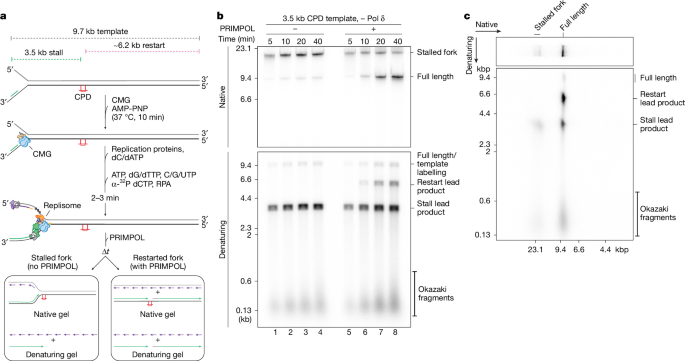
To investigate leading-strand repriming by PRIMPOL in the context of the replisome, we leveraged a system that we recently developed to assemble fast and efficient human replisomes from purified proteins20. In this approach, CMG is first loaded onto the forked end of a 9.7-kb DNA template before additional proteins are added to assemble replisomes that perform robust leading- and lagging-strand DNA replication (Fig. 1a). Pol ε performs the bulk of leading-strand synthesis, whereas Pol α–primase and Pol δ replicate the lagging strand. RFC and CTF18-RFC load the polymerase processivity factor PCNA onto the lagging and leading strands, respectively, and TIMELESS (TIM)–TIPIN, CLASPIN and AND1 associate with CMG to promote ra