// NATURE NEWS — SPAZIO & SCIENZA
Metasurface waveguides for all-day augmented reality glasses
Nature
(2026) Cite this article
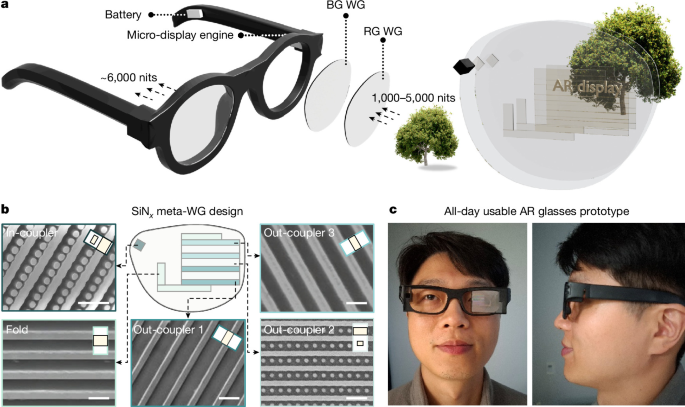
Augmented reality (AR) displays, originating from early optical see-through head-mounted systems1, have evolved towards lightweight glasses that seamlessly integrate digital information with the physical world2,3. However, their widespread adoption requires compact optical systems that enable bright, wide-field and comfortable viewing. Diffractive waveguides (WGs) offer a promising approach towards lightweight AR displays yet face inherent trade-offs among field of view (FoV), optical efficiency and eyebox size owing to limited degrees of freedom in light control. Here we show an all-day-wearable AR glass prototype based on spatially varying, interwoven metasurfaces that provide several grating vectors for multidirectional light control. The resulting dual-layer metasurface-based waveguide (meta-WG) achieves a 30° FoV and an 8 × 8-mm2 two-dimensional (2D) eyebox while maintaining an average luminance efficiency of 1,938 nits lm−1 (up to 4,225 nits lm−1) within a 1.5-mm-thick form factor. The prototype produces bright and stable virtual images under outdoor ambient illumination, demonstrating the compatibility of meta-WGs with practical wearable display requirements. By expanding the degrees of freedom for light routing beyond conventional diffractive WGs, our approach provides a scalable framework for balancing efficiency, viewing range and form factor, bringing high-performance AR glasses closer to practical consumer applications.
This is a preview of subscription content, access via your institution
Access Nature and 54 other Nature Portfolio journals
Get Nature+, our best-value online-access subscription
Prices may be subject to local taxes which are calculated during checkout
Data supporting the findings of this study can be obtained from the corresponding author on request.
Sutherland, I. E. A head-mounted three dimensional display. In Proc. December 9-11, 1968, Fall Joint Computer Conference, Part I (AFIPS ’68 (Fall, Part I)) 757–764 (Association for Computing Machinery, 1968).
Carmigniani, J. & Furht, B. in Handbook of Augmented Reality 3–46 (Springer, 2011).
Xiong, J., Hsiang, E.-L., He, Z., Zhan, T. & Wu, S.-T. Augmented reality and virtual reality displays: emerging technologies and future perspectives. Light Sci. Appl. 10, 216 (2021).