// SPACE.COM — SPAZIO & SCIENZA
Thanksgiving night sky 2026 — What to look for after dinner tonight
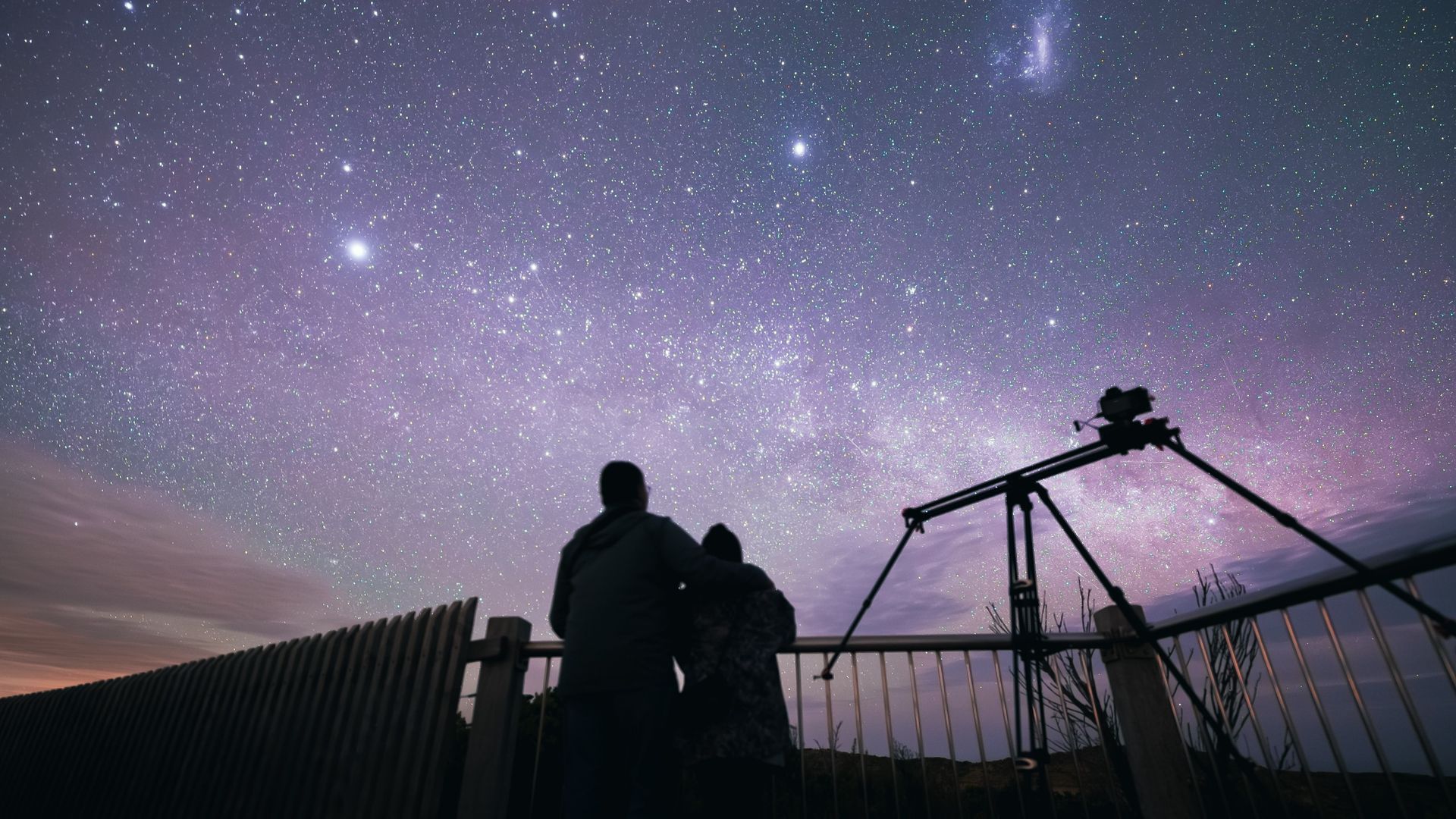
From Saturn's magnificent rings to the waning gibbous moon, here's how to turn your Thanksgiving celebrations into a family skywatching adventure.
When you purchase through links on our site, we may earn an affiliate commission. Here’s how it works.
If your household is like most American families, then on Thursday you likely will all be sitting down with family and friends for a traditional Thanksgiving turkey dinner during the mid-to-late afternoon hours.
Then as darkness falls, some will probably migrate into the living room to catch some football or other holiday fare on television. But if you have a large gathering of family and friends at your home — and if your skies are mainly clear — why not invite everyone outside to gaze at the evening sky?
If you have binoculars, or better yet, a telescope, you just might end up turning this into a memorable family tradition of its own.
If I may paraphrase the mysterious voice from the 1989 movie, "Field of Dreams": "If you set up your telescope, they will come." And you'll get a big kick out of your Turkey Day guests uttering all the "oohs" and "ahs" or exclamations of "Wow!" with just one peek through the eyepiece.
As darkness falls, Saturn will glow at first magnitude, shining with a sedate, yellow-white light and appearing noticeably brighter than the star Fomalhaut, about 40 degrees (the equivalent of four fist-widths) to its lower right.
Its famous ring system is now tilted only about six degrees toward Earth but may be visible with steadied (or image-stabilized) high-power binoculars or through the eyepiece of a telescope magnifying over 30-power. The rings will seem to glow with an inner light and for those who have never had the pleasure of seeing them for themselves, that first view always elicits astonishment; kids especially most often will say: "Awesome!" or "No way!" I've even had people accuse me of using a slide of Saturn, to which I, of course, reply with, "No . . . that's the real thing."
Then, along about 6:25 p.m. local time, the waning gibbous moon, 2½ days past full phase and 91% illuminated, will begin to emerge from beyond the east-northeast horizon. Give it another hour and it will stand about 10 degrees above the horizon — equal to the width of your clenched fist held at arm's length. By then, the moon will be in a better position for evening study.
Even in binoculars, the moon is a striking sight to see. It's such a special object because it doesn't matter whether you live in a rural area or in the middle of a brightly lit city, for the moon can always be readily observed. It always looks spectacular whether you're using binoculars or a telescope. It never looks precisely the same no matter how often you view it and can be observed even on hazy or partially cloud-covered nights.