// SPACE.COM — SPAZIO & SCIENZA
How a huge fleet of 17 spacecraft discovered something surprising about solar eruptions
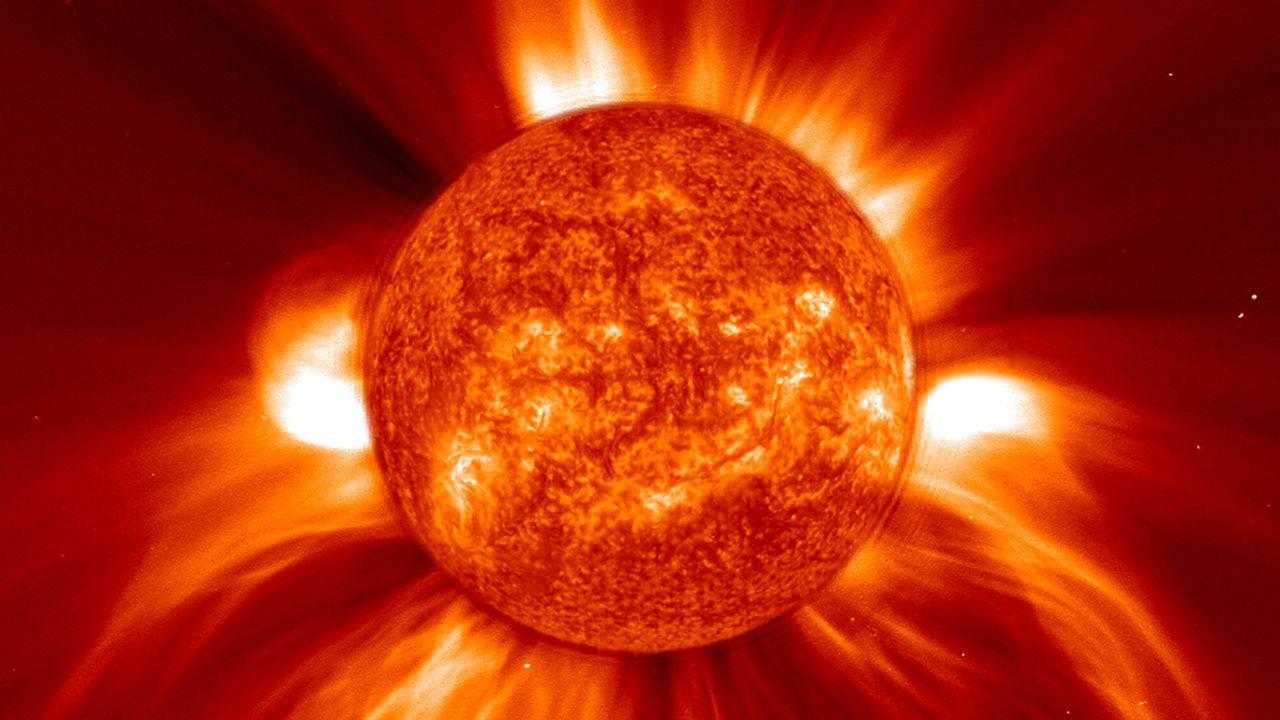
Taking measurements of the same CME from different vantage points in the solar system revealed the true extent of a solar eruption.
When you purchase through links on our site, we may earn an affiliate commission. Here’s how it works.
A misbehaving coronal mass ejection (CME) that blew out a hidden cloud of charged particles aimed at Earth has been tracked by a record 17 spacecraft spread throughout the solar system, revealing the CME to be surprisingly lopsided.
CMEs are "burps" from the sun – huge clouds of magnetized plasma belched out from the sun's hot outer atmosphere, the corona, by the energy resulting from a solar flare. The magnetized CME cloud then expands out into the solar system, and the charged particles that the cloud contains are a significant radiation hazard to astronauts, spacecraft and even passengers on jet liners, but they also have a beautiful side as they can trigger the beautiful lights of the aurora when they intercept Earth.
CMEs occur on a regular basis, but one that erupted from the sun at 00:48 UT (7:48 p.m. ET) on Dec. 15, 2024 proved to be rather special.
"We used observations from 17 spacecraft to track and characterize this CME," Adrienn Luspay-Kuti of Johns Hopkins University Applied Physics Laboratory, who led the research that drew all the observations together, told Space.com. "This was a record number of spacecraft for tracking and characterizing a single CME, and gave us an exceptionally detailed view of how the CME evolved."
The previous record had been 10 spacecraft, but they had mostly been in a rough line from the sun through to the Earth and beyond, meaning that their measurements were somewhat one-dimensional. This time, for the December 2024 CME, the spacecraft were spread far and wide, not just at different distances from the sun, but also substantially wide of the Earth–sun line.
They revealed that the CME had two asymmetric lobes, one moving faster than the other. One of those lobes, which headed for Earth and Mars, would have gone unseen, obscured by the larger but slower lobe that left the sun at a tangent, were it not for the wide spread of the spacecraft.
"Our observations showed a fast lobe propagating through the Earth–Mars sector and a much slower lobe farther west toward STEREO-A," said Luspay-Kuti. STEREO-A is one half of NASA's two-spacecraft space weather monitoring system known as the Solar Terrestrial Relations Observatory.
The onset of the CME was seen by the joint NASA–ESA Solar and Heliospheric Observer (SOHO), which has been constantly monitoring the sun for more than 30 years. Yet it only saw the slower lobe that erupted at an angle to Earth; the faster lobe heading for our planet was missed, obscured by the slower, larger lobe.